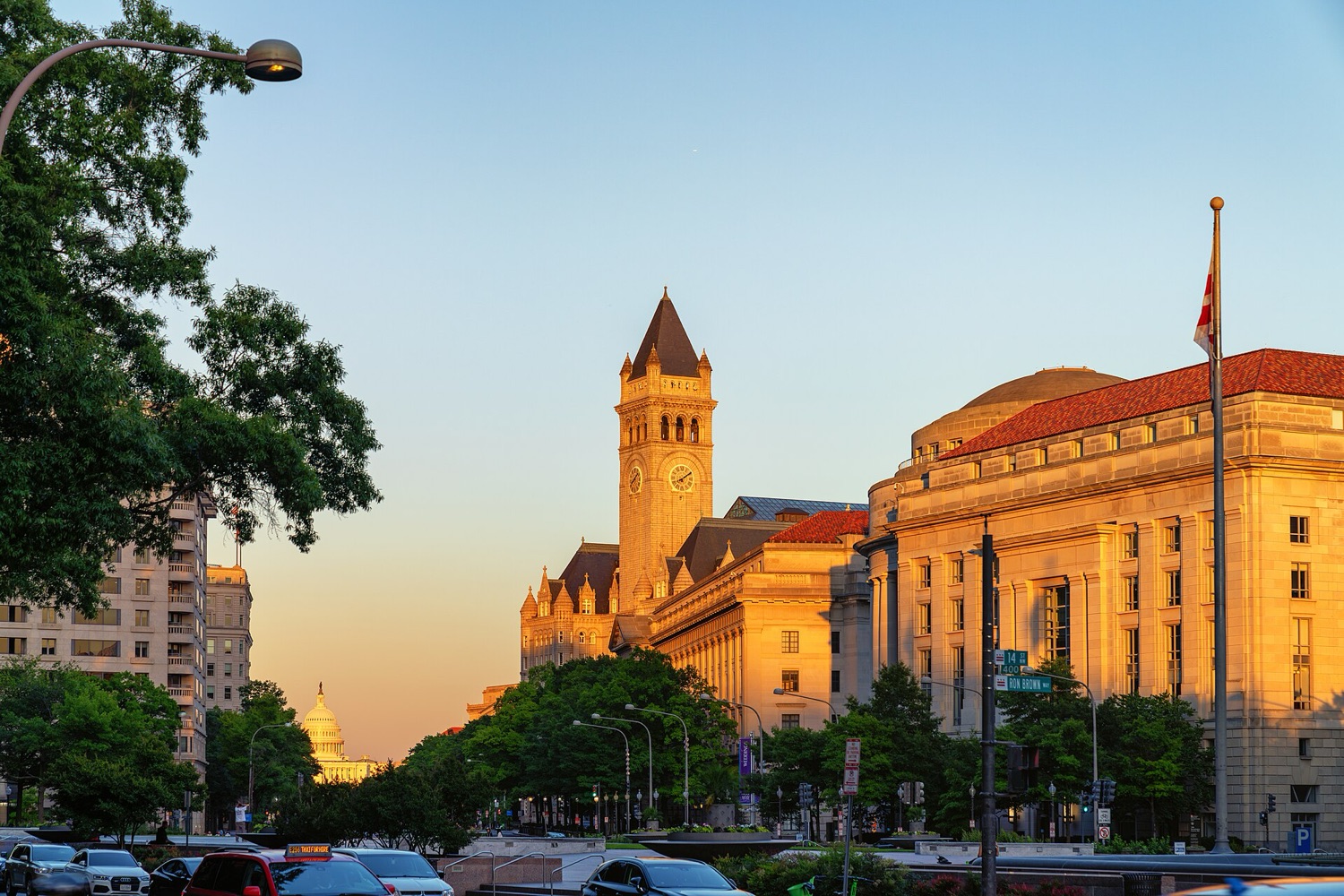
Before a federal agency can do something significant with federal property, the National Environmental Policy Act (NEPA) asks it to stop and look at the consequences, and to let the public look too. The Old Post Office redevelopment is a clear, compact example of how that works.
NEPA in plain English
NEPA was signed into law on January 1, 1970. It does not forbid projects and it does not set environmental limits. It is a procedure: an agency must study the likely effects of a proposed federal action, consider alternatives, and give the public a chance to comment before deciding. There are three common levels of review:
| Level | When it is used | Typical outcome |
|---|---|---|
| Categorical exclusion | Routine actions known to have no significant effect | No further study |
| Environmental Assessment (EA) | Actions whose effects are uncertain | A Finding of No Significant Impact (FONSI), or a decision to go further |
| Environmental Impact Statement (EIS) | Actions likely to have significant effects | A full statement and a Record of Decision |
"Environment" in NEPA means the human environment, not only trees and water. For a historic building in the middle of a city, that means traffic, views, public space, historic character and local economics as much as stormwater.
The Old Post Office Environmental Assessment
GSA prepared an Environmental Assessment of the proposed redevelopment of the building at 1100 Pennsylvania Avenue NW under Section 102 of NEPA. The stated purpose and need was simple: to comply with the Old Post Office Building Redevelopment Act of 2008, which authorised and directed GSA to redevelop the building and its Pavilion Annex, consistent with a plan approved by the relevant committees of Congress.
The assessment compared two alternatives:
- Action Alternative: redevelopment by the selected developer as a mixed-use luxury hotel and conference facility, with hotel rooms and suites, museum space, restaurants, retail space, a bar and lounge, an exhibition gallery, a library and seating area, a spa and health club, a gift shop, a ballroom and conference space. The clock tower would remain open to the public.
- No Action Alternative: the continued maintenance and operation of the building and Pavilion Annex as they were.
What was studied
The EA looked in detail at the potential effects of both alternatives on a long list of topics:
- Land use and planning policies
- Public space
- Cultural resources
- Visual resources
- Socioeconomics
- Vegetation
- Stormwater management
- Floodplains
- Air quality
- Transportation, vehicular and non-vehicular
- Parking
- Utilities
- Energy use and sustainability
A separate transportation study supported the traffic and parking chapters, an important point on a block where tour buses, delivery trucks, taxis and inauguration parades all compete for kerb space.
Public review and the FONSI
In May 2013 the Final EA and a signed Finding of No Significant Impact were made available to the public, other federal and local agencies and stakeholders for a 30-day review, with comments accepted until June 21, 2013. The FONSI would become final unless new information pointed the other way. Because part of the land around the building was under National Park Service jurisdiction and was to be transferred to GSA, the Park Service adopted GSA's EA under its own NEPA rules (43 CFR 46.320) and issued its own decision document.
Why no full EIS? The project reused an existing building, kept its exterior and principal interior spaces, and continued a long-established commercial use of the lower floors. The assessment concluded that its effects would not be significant, so an Environmental Impact Statement was not required.
NEPA and Section 106 together
NEPA ran in parallel with consultation under Section 106 of the National Historic Preservation Act, which deals specifically with historic properties. The two processes share information but are legally separate. Our companion page, Section 106 explained, follows that track. The broader story is on the redevelopment timeline.
This page is an independent explanation for general readers, based on the public record of 2012–2013. It is not a government notice, and the comment period it describes closed in 2013.