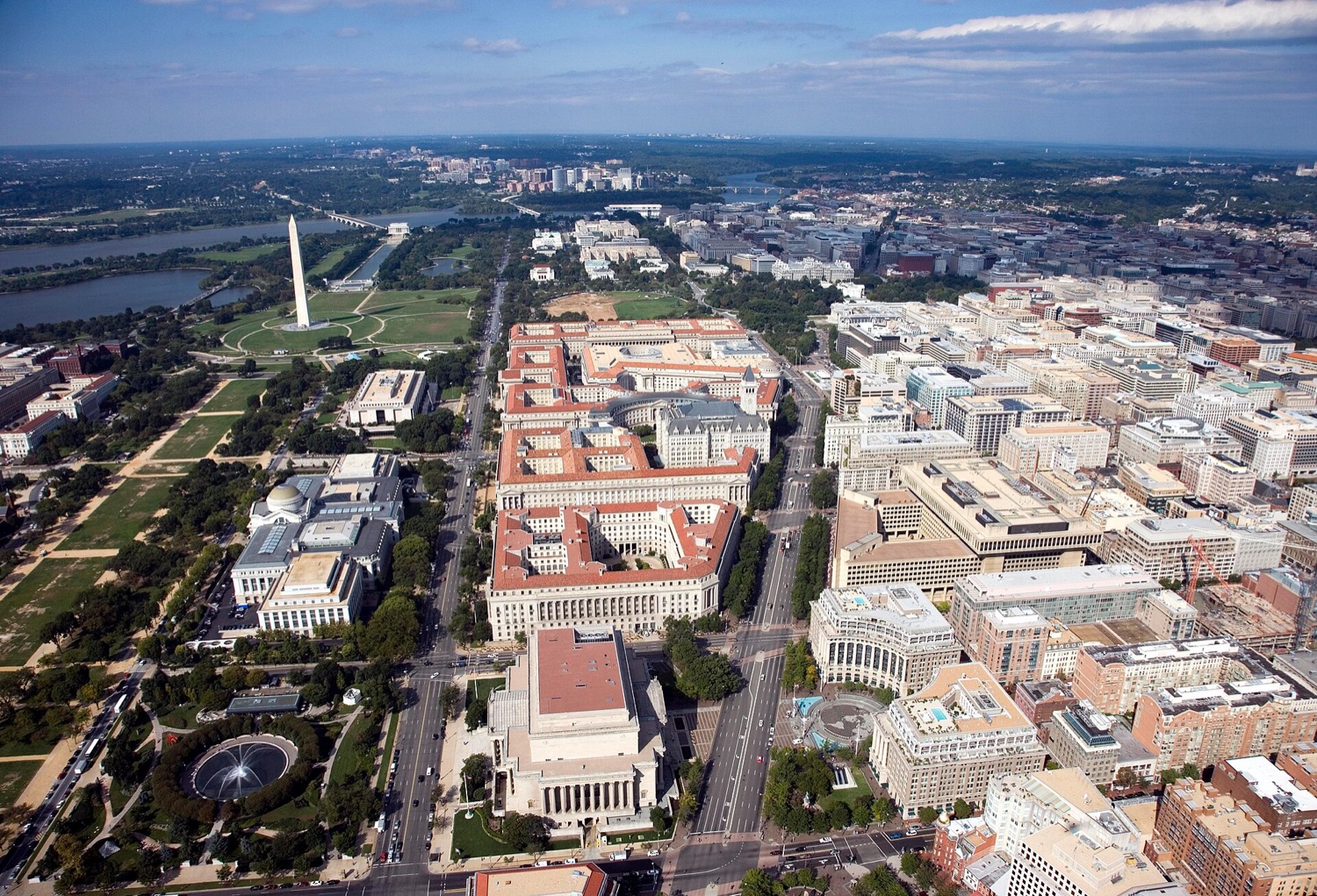
The Federal Triangle is the wedge of land between Pennsylvania Avenue, Constitution Avenue and 15th Street NW. Today it is a single, solemn composition of limestone offices with red tile roofs. A hundred years ago it was one of the liveliest and least respectable parts of Washington, and the Old Post Office was its only grand public building.
Before the Triangle
In the nineteenth century the low ground south of Pennsylvania Avenue held the Center Market, warehouses, boarding houses and a district so notorious that it was known as Murder Bay. Along the avenue itself stood hotels, saloons and, before the Civil War, private gambling rooms where members of Congress were said to lose heavily at faro. Our story on Pennsylvania Avenue looks at that world in more detail.
The 1926 plan
The Public Buildings Act of 1926 gave the Treasury, under Secretary Andrew Mellon, the money and the mandate to replace the district with a planned group of federal offices. A board of leading architects agreed a common language: classical facades in limestone, uniform cornice lines, red tile roofs and interior courtyards. Each building had its own architect, but the ensemble was meant to read as one.
The Triangle at a glance
- Area
- Between Pennsylvania Ave, Constitution Ave and 15th St NW
- Plan
- Public Buildings Act of 1926
- Main construction
- Late 1920s to late 1930s
- Completed
- The Ronald Reagan Building, opened in 1998, filled the last major site
- Oldest building
- The Old Post Office, 1899
Buildings that went up
| Building | Notes |
|---|---|
| Department of Commerce (Herbert C. Hoover Building) | The largest office building in the world when completed in the early 1930s |
| Internal Revenue Service | One of the first Triangle buildings |
| Department of Justice (Robert F. Kennedy Building) | Known for its art deco aluminium details |
| National Archives | Built on the site of the old Center Market |
| Post Office Department (now the William Jefferson Clinton Federal Building) | Across 12th Street from the Old Post Office; the department moved there in 1934 |
| Federal Trade Commission | At the narrow eastern tip of the Triangle |
The building that did not fit
In the plan the Old Post Office was supposed to disappear. Its Romanesque arches, tall tower and granite walls clashed with the classical uniformity around it. But the Depression stopped work before it could be demolished, and the gap where a "Grand Plaza" was meant to go stayed a parking lot for decades. Today most visitors see the contrast as the Triangle's best feature: the one building with a skyline, a clock and a sense of humour. For the long campaign to keep it, read Don't Tear It Down.
Visiting the Triangle
The Federal Triangle Metro station (Blue, Orange and Silver lines) opens right onto the precinct. A short walk takes in the Old Post Office, the National Archives, the Ronald Reagan Building and the Benjamin Franklin statue in front of the post office. Our DC weekend itinerary strings them together.